
The Great Pyramid of Giza: How Old Kingdom Egypt Organised the Work
More than a tomb, the Great Pyramid of Giza was a triumph of ancient Egyptian logistics, drawing resources and human effort on an unimaginable scale. It stands as a testament to the Old Kingdom’s administrative power.
Rising 146 meters above the Giza plateau, the Great Pyramid of Khufu is not merely a monumental tomb but a profound statement of human organisational capacity. It demanded the movement and precision placement of roughly 2.3 million stone blocks, each weighing between 2.5 and 15 tons. Stacked over two decades, this edifice contains enough material to construct a wall one foot thick and ten feet high, stretching halfway around France. It was a project that unified the fledgling Egyptian state, focusing its entire economic and human resource might on a single, audacious goal.
The scale of the undertaking required more than brute force; it necessitated a sophisticated administrative system. The vision belonged to Pharaoh Khufu, but its execution fell to individuals like Hemiunu, his vizier and chief architect. He oversaw a workforce estimated to be between 20,000 and 30,000 people at any given time. This was not a slave army, but a highly organised labour force of skilled craftsmen, quarrymen, stonecutters, carpenters, and a vast seasonal contingent of farmers who worked during the Nile’s annual inundation, when their fields were submerged.
Mobilising the Workforce
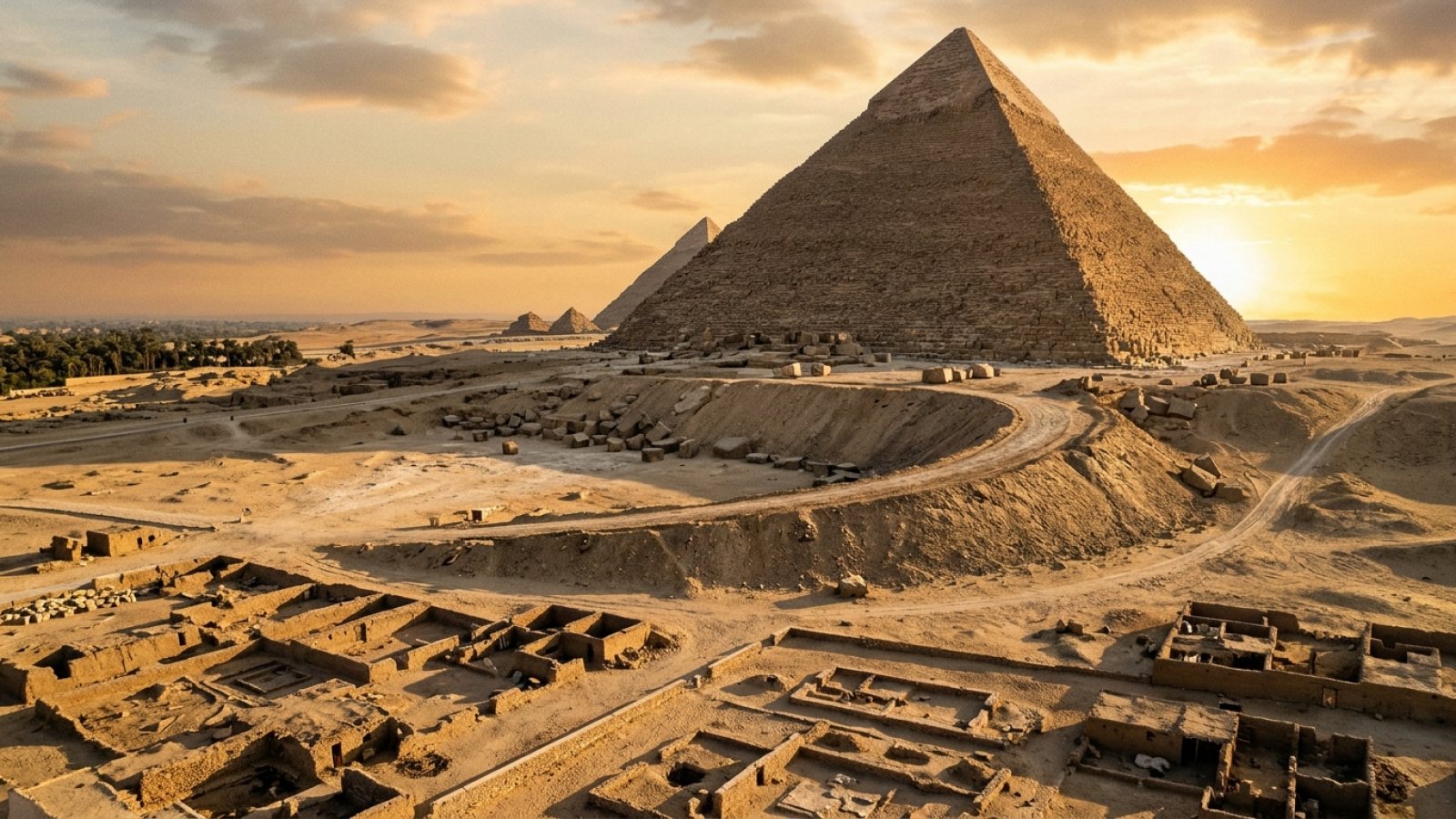
The logistics of sustaining such a massive workforce were as impressive as the construction itself. Archaeological discoveries around the Giza plateau have revealed a sprawling worker’s village, a veritable city of pyramid builders. Excavations have unearthed bakeries capable of producing thousands of loaves daily, fish processing plants, and extensive food storage facilities. This infrastructure points to a centrally planned system designed to house, feed, and equip tens of thousands, ensuring their health and productivity for the duration of the project. The workers were paid, often in rations, and afforded medical care, demonstrating a level of societal organisation far beyond simple coercion.
Raw materials arrived from across Egypt. The bulk of the pyramid’s core was quarried from the local Giza limestone plateau. Finer, lighter-coloured limestone for the outer casing came from Tura, across the Nile. The most challenging materials were the massive granite blocks used for the burial chambers and relieving stones, sourced from quarries near Aswan, over 800 kilometers to the south. These colossal stones, some weighing up to 70 tons, were transported downstream on specially constructed barges during the annual flood, then hauled overland to the construction site.
Engineering the Ascent
Once at the site, the greatest challenge was moving these immense blocks upwards. While the exact methods remain a subject of academic debate, the prevailing theory involves the use of massive earthen ramps. Various ramp designs, including straight, spiral, or a combination of both, would have allowed teams of workers to drag the heavy stones on sledges. Water or mud may have been used to lubricate the path, reducing friction. For the final, precise placement of the outer casing stones, and the pyramidion at the summit, the ramp system would have been systematically dismantled from the top down, allowing for meticulous finishing work.
Precision was paramount. The pyramid’s base covers over 53,000 square meters, yet its four sides deviate in length by less than 58 millimeters. Its corners are almost perfectly oriented to the cardinal points, with an error of less than one-tenth of a degree. This accuracy was achieved using remarkably simple tools: plumb bobs, set squares, and astronomical observations for alignment. The construction wasn't just about stacking stones; it was a monumental exercise in surveying, geometry, and meticulous planning, executed by a highly skilled workforce.
Enduring Legacy
The cost of the Great Pyramid was immense. It consumed national resources for two decades, diverting vast quantities of food, labour, and materials. The work was arduous and dangerous, and while archaeological evidence shows injured workers received care, accidents were an inevitable part of such a hazardous enterprise. Yet, the achievement transformed Egypt. It solidified the pharaoh’s divine authority, honed the state’s administrative capabilities, and provided generations of skilled workers with purpose and employment. It became the ultimate expression of Old Kingdom power and stability.
Today, the Great Pyramid of Giza is the oldest and only remaining of the Seven Wonders of the Ancient World. It stands as a timeless testament to what a unified human endeavour, organised on an epic scale, can achieve. It is a structure built not just of stone, but of a nation’s collective will, ingenuity, and profound belief in its enduring legacy.
