
The Isthmus Severed: Building the Suez Canal, 1859-1869
For ten years, tens of thousands of workers toiled to cut a hundred-mile shipping lane between two continents. The Suez Canal remains one of history’s most profound reshaping of global geography.
In 1859, the land bridge between Africa and Asia, the Isthmus of Suez, was a formidable expanse of desert, rock, and salt marsh. It was a barrier that forced ships to travel thousands of extra miles around the Cape of Good Hope, adding months to voyages between Europe and Asia. For centuries, the dream of a direct waterway lingered, but the sheer scale of the undertaking made it seem impossible. Yet, over the next ten years, an international corporation, driven by the vision of one man and the muscle of tens of thousands, would carve a hundred-mile channel, forever altering global trade and geopolitics.
The driving force was Ferdinand de Lesseps, a French diplomat with no engineering experience, but immense conviction and persuasive power. His plan was simple in concept: a sea-level canal, without locks, connecting the Mediterranean to the Red Sea. The physical challenge, however, was immense. The proposed route stretched approximately 160 kilometers (about 100 miles) from Port Said on the Mediterranean to Suez on the Red Sea, requiring the excavation of an estimated 75 million cubic meters of sand, rock, and clay. To put this into perspective, this volume is enough material to fill the Great Pyramid of Giza nearly 30 times over. It was an earthmoving project on a scale unseen before, demanding unprecedented resources and human labor.
The Human Engine
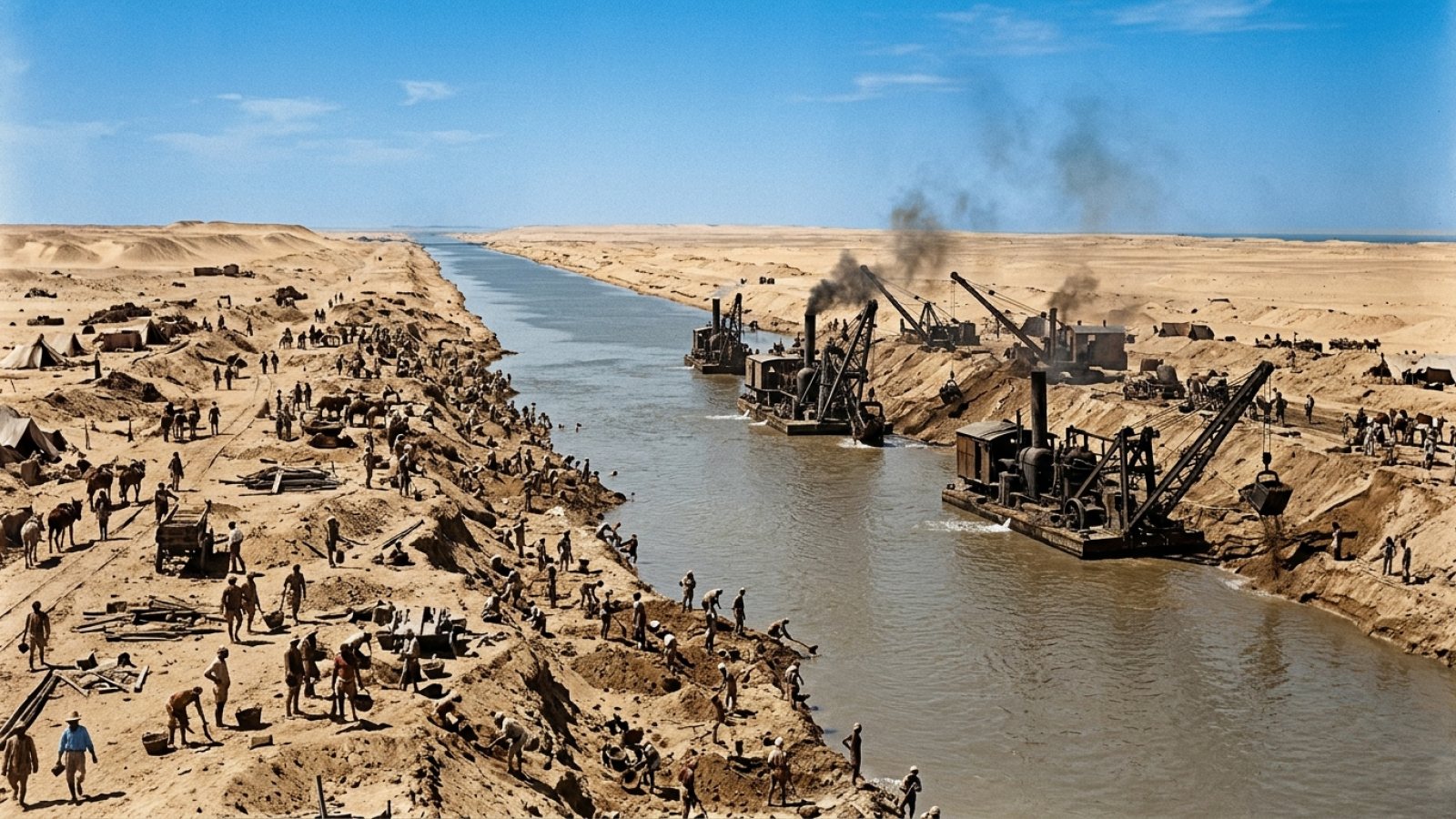
Early work relied almost entirely on manual labor. Tens of thousands of Egyptian laborers, primarily *fellahin* (farmers) drafted through the traditional system of forced labor known as corvée, formed the backbone of the workforce. Armed with pickaxes, spades, and wicker baskets, they toiled under the blistering desert sun. The conditions were brutal. Fresh water was scarce, supplied initially by camel caravans and later by the construction of a parallel freshwater canal, the Ismailia Canal, which itself was a monumental undertaking.
Disease, including cholera and dysentery, was rampant in the crowded, unsanitary work camps. Estimates of lives lost, primarily among the forced laborers, vary widely but often exceed 30,000, with some accounts suggesting far higher tolls from disease and brutal conditions over the project's duration. The corvée system, a legacy of ancient Egypt's monumental construction, generated international outcry and was eventually abolished in 1864, leading to a crucial shift in the project's methodology.
A New Global Artery
The abolition of corvée labor forced the Suez Canal Company to rapidly mechanize. Gigantic steam-powered dredgers and excavators, many specially designed for the project, were brought in from Europe. These machines, capable of moving thousands of cubic meters of earth per day, dramatically accelerated progress, particularly in the deep cuts through difficult terrain. This technological pivot was a turning point, allowing the project to proceed at a pace impossible with manual labor alone.
Financially, the canal's construction was a vast undertaking, costing approximately 433 million French francs by its completion in 1869. The project faced not only engineering and logistical hurdles but also significant political opposition, particularly from Britain, which feared French dominance of a new trade route. De Lesseps navigated these political waters with the same determination he applied to the physical challenges.
On November 17, 1869, the Suez Canal officially opened. The impact was immediate and profound. The journey from London to Bombay, for example, was cut by over 4,000 miles. It transformed global shipping, dramatically reducing travel times and costs, facilitating the movement of goods, people, and ideas across continents. The canal reshaped geopolitical power, becoming a vital artery that nations would vie to control.
Today, the Suez Canal remains one of the world's most critical waterways, a testament to the immense human will and collective effort that can reshape geography. Its construction stands as a stark reminder of both the extraordinary achievements of industrial-era engineering and the profound human cost often borne by those who did the work.
