
The Unseen Army: The Hundreds of Thousands Who Built Apollo 11
When Neil Armstrong took humanity's first steps on the Moon, an estimated 600 million people watched, but few truly grasped the immensity of the effort on Earth. About 400,000 people across the United States worked for years to achieve that single moment.
When Neil Armstrong took humanity's first steps on the Moon, an estimated 600 million people watched, but few truly grasped the immensity of the effort on Earth. That single moment, televised globally on July 20, 1969, was the culmination of work by nearly half a million people, a collective national project driven by a bold, often impossible-seeming deadline.
A Nation's Assembly Line: The Scale Made Human
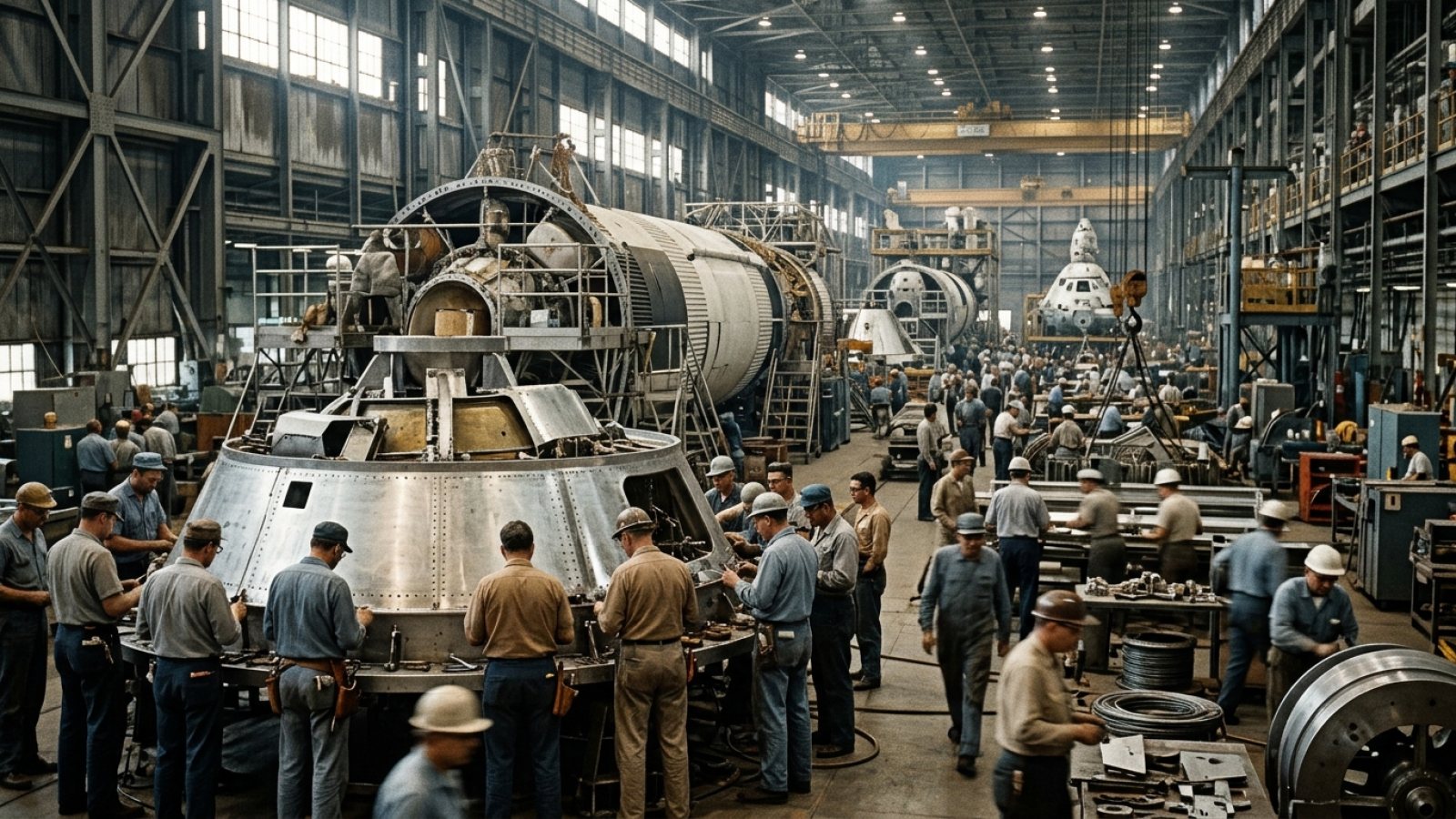
To put the scale into perspective, the Apollo program, from conception to lunar landing, directly employed roughly 400,000 Americans at its peak. This workforce was larger than the population of many major cities at the time, equivalent to filling a modern sports stadium five times over. They hailed from every state, working for NASA itself or one of the over 20,000 contractors and subcontractors across industries ranging from heavy manufacturing to precision electronics, from garment factories to food services.
These were not just rocket scientists. They were the seamstresses who sewed the multi-layered spacesuits and parachutes, the welders who fused the massive segments of the Saturn V rocket, the mathematicians and early computer programmers like Katherine Johnson, Dorothy Vaughan, and Mary Jackson who charted trajectories, and the civil engineers who designed launch pads and assembly buildings unlike anything seen before. Doctors, nutritionists, administrators, security personnel, and countless logistical support staff all played critical, interconnected roles. This human engine transformed raw materials into a machine capable of spanning a quarter of a million miles of vacuum, delivering three humans safely to the Moon and back.
The Hard Part: Orchestrating the Unprecedented
The core problem of Apollo was not just inventing new technologies, but integrating them on an unimaginable scale and doing so under immense pressure. President Kennedy's 1961 declaration to land a man on the Moon and return him safely before the decade was out gave NASA a clear goal, but no blueprint. It demanded a level of scientific, engineering, and managerial coordination that had no precedent in human history, outside of wartime mobilization.
NASA Administrator James Webb oversaw this gargantuan enterprise, balancing scientific ambition with political realities and the challenges of managing such a diverse industrial base. Teams at NASA centers like Marshall Space Flight Center, led by Wernher von Braun, designed the propulsion systems, while the Manned Spacecraft Center (now Johnson Space Center) in Houston focused on spacecraft development and mission operations. Contractors like North American Aviation (Command/Service Module) and Grumman (Lunar Module) faced immense technical hurdles, from designing heat shields that could withstand re-entry temperatures to crafting ultra-lightweight landers for the lunar surface. Mistakes were costly; the tragic loss of the Apollo 1 crew during a launchpad test fire in 1967 brought harsh lessons and led to a complete overhaul of safety protocols and materials, further highlighting the human cost and the relentless pursuit of perfection.
The Cost, The Legacy, The Enduring Impact
The Apollo program came at a significant cost. Roughly $25 billion was spent in 1960s dollars, a sum equivalent to over $200 billion today, representing about 2.5% of the United States' Gross National Product at its peak. This investment, however, yielded breakthroughs across countless fields: miniaturized electronics, advanced materials, computing technologies, and new management techniques that reshaped industries.
More than the tangible inventions, Apollo changed humanity's perspective. It demonstrated a collective capacity for achievement previously thought impossible, inspiring generations of scientists and engineers worldwide. The Moon rocks brought back by the Apollo missions continue to yield secrets, informing our understanding of planetary geology. The command module Columbia, which carried the Apollo 11 crew to the Moon and back, stands today as a testament to the thousands of hands and minds that built it, a physical manifestation of a singular human endeavor. The infrastructure developed for Apollo, from launch complexes to mission control rooms, continues to support new generations of space exploration. The spirit of collaboration and problem-solving that defined Apollo 11 remains a powerful blueprint for confronting the largest challenges of the future.
